
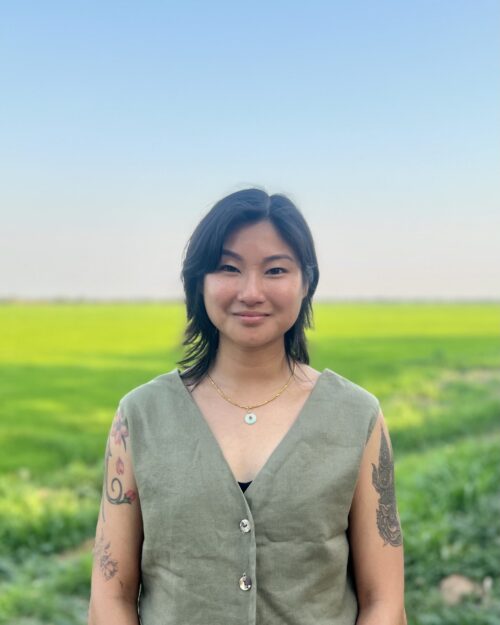
Sophia Ou LPC
License No. 178.018713
Licensed Professional Counselor
National Certified Counselor
BCBS PPO, Blue Choice, & Aetna
Areas of Focus
Hi! My name is Sophia. I am a Nationally Certified and Licensed Professional Counselor. I am passionate about supporting the intersectionality of marginalized groups, including queer, trans, and people of color. My areas of focus are trauma recovery, racial, sexual, gender identity development, childhood trauma, attachment, relational difficulties, anxiety, and depression.
I am a queer nonbinary person who is a descendant of Khmer (Cambodian) refugees and genocide survivors. I grew up in a single-parent, low-income household in the suburbs of Chicago. In my upbringing and being socialized as a woman, I was taught little about the importance of community and of receiving care. I was fiercely hyper-independent and focused on building my family’s stability through productivity and working nonstop. While these strategies were necessary for my family’s survival, my survival techniques left me moving through the world with a hardened shell, burnt out, and disconnected from my body.
In my own therapy journey, I often felt misunderstood, invisible, and unsatisfied with the care I received. I felt I was over-explaining my cultural experiences. There was also a large emphasis on my thought patterns as the source of my suffering that left me feeling more disembodied. Thus, I value incorporating culturally responsive care. I consider the complexity of clients as whole persons within a social systems and intersectional framework. I work best with clients who want to build a more mindful, curious, and compassionate relationship with themselves while centering pleasure and softness. I have supported my clients with intergenerational trauma/healing, attachment issues, neurodivergence, perfectionism, workaholism, marginalization, identity, belonging, and relational healing.
I believe in the power of connecting with our body’s wisdom and healing in community. In doing this, we can discover more parts of ourselves and how they show up relationally. I believe that we have multiple parts within us, each with its own thoughts, emotions, and motivations. Some of our parts may carry distressing thoughts or emotions. We often push away these feelings and reach for coping skills that may be misaligned with the life we want to live. When we can accept these uncomfortable feelings with curiosity and compassion, they can guide us into deeper knowledge of our internal and relational needs. Capitalism and oppression can cause us to disconnect from our bodies in service of survival. Those of us with marginalized identities might have learned that it wasn’t safe to feel or make room for feelings. In connecting with our body’s innate wisdom, we are resisting oppressive structures and restoring ourselves as whole persons.
The therapy approaches that most resonate with me are internal family systems (IFS), mindfulness, somatic, relational, and solution-based approaches. My practice is warm, compassionate, experiential, consent-based, and direct. Therapy is always centered around you and your needs. I prioritize holistic therapy that takes the mind, body, and spirit into consideration, and is rooted in resisting and healing the impacts of oppression. This means that I am continually reflecting on my privilege, position, and power as a queer, able-bodied therapist. I am committed to understanding and respecting the unique intersections and experiences of all of my clients. I understand that therapy is not a one-size-fits-all approach. Ultimately, I am here to empower you to reclaim and discover your inner voice, support you, walk with you, and challenge you. We will work together to explore and clarify your values, learn new tools, establish rituals, and cultivate a mindful life, clearing a path toward your goals.
Capitalism and oppression can cause us to disconnect from our bodies in service of survival. Those of us with marginalized identities might have learned that it wasn’t safe to feel or make room for feelings. In connecting with our body’s innate wisdom, we are resisting oppressive structures and restoring ourselves as whole persons.
In an effort to decolonize mental health and create safer therapeutic spaces for BIPOC folks, my practice focuses on strengthening the mind-body connection and raising awareness of how systems of oppression can negatively impact well-being. I take into consideration the complex dynamics occurring with you on the individual, societal, environmental, and institutional levels and how they impact your inner world. My goal is to help you foster liberation, empowerment, and consciousness raising as we address oppression and its impact on these levels. I welcome all healing approaches that feel right for you, including ancestral, spiritual, or cultural. Growing up with traumatized adults who are weary of the medical-industrial complex taught me about other valuable healing approaches. I witnessed the use of plant medicine, gardening, and connecting with Earth as a form of abundance and healing. There are a wide array of approaches that practitioners can and do use, and I’m committed to working with you to find the approaches that best fit your needs.
Somatic-based (body-centered) practices coupled with verbal processing can assist you with addressing trauma. The body can store traumatic memories beyond our immediate consciousness, which might result in misaligned responses, making us feel “stuck.” Before we can move closer to change it’s important to understand the body’s pattern and mechanisms of protection to identify the support you need. Therefore, these practices can help metabolize your emotions to uncover, attune to your needs and deepen the understanding of your body’s messages. Somatic therapy might look like: connecting to your body through your senses, developing language to describe what’s occurring in your body, exploring body sensations and impulses towards movement or stillness, or practicing somatic embodiment with memories. In embodying our emotions, we tend our internal soil, making it more fertile so that we can grow from places of nourishment, rooted in our values, without needing to act impulsively from a place of ungroundedness, reactivity, or falling into numbness.
Outside of the therapy space, I enjoy listening to people’s stories, connecting to the land, creating community spaces, and engaging in activities that promote my well-being. You’ll find me involved in social justice advocacy through mutual aid and organizing community spaces for collective grief and rage. I have been in involved in advocacy work for survivors of sexual assault and domestic violence and have helped families seeking asylum resettle in the Chicago area.
In my free time, I love to cook ancestral foods and to grow closer to my family lost during the genocide. I also participate in and offer Khmer language classes with my auntie for the Cambodian-American community. You can find me at home cuddling with my cat, Bernie, dancing, lifting weights, or doing yoga.